Construction guide · Updated 2026
Tennis court construction
is a drainage project first
Tennis court construction means grading a 120 by 60 foot area, placing a compacted stone base, building a slab (post-tension concrete, reinforced concrete or asphalt) at a 1 percent slope, and finishing it with an acrylic hard-court system, clay, or synthetic turf. A single outdoor hard court takes 6 to 10 weeks and costs $50,000 to $120,000.
It is built by tennis court builders, specialist contractors who handle the base, slab, surface, nets and fence, often ASBA Certified. A general contractor can pour the slab, but the tolerances for a tennis court are tighter than a driveway.
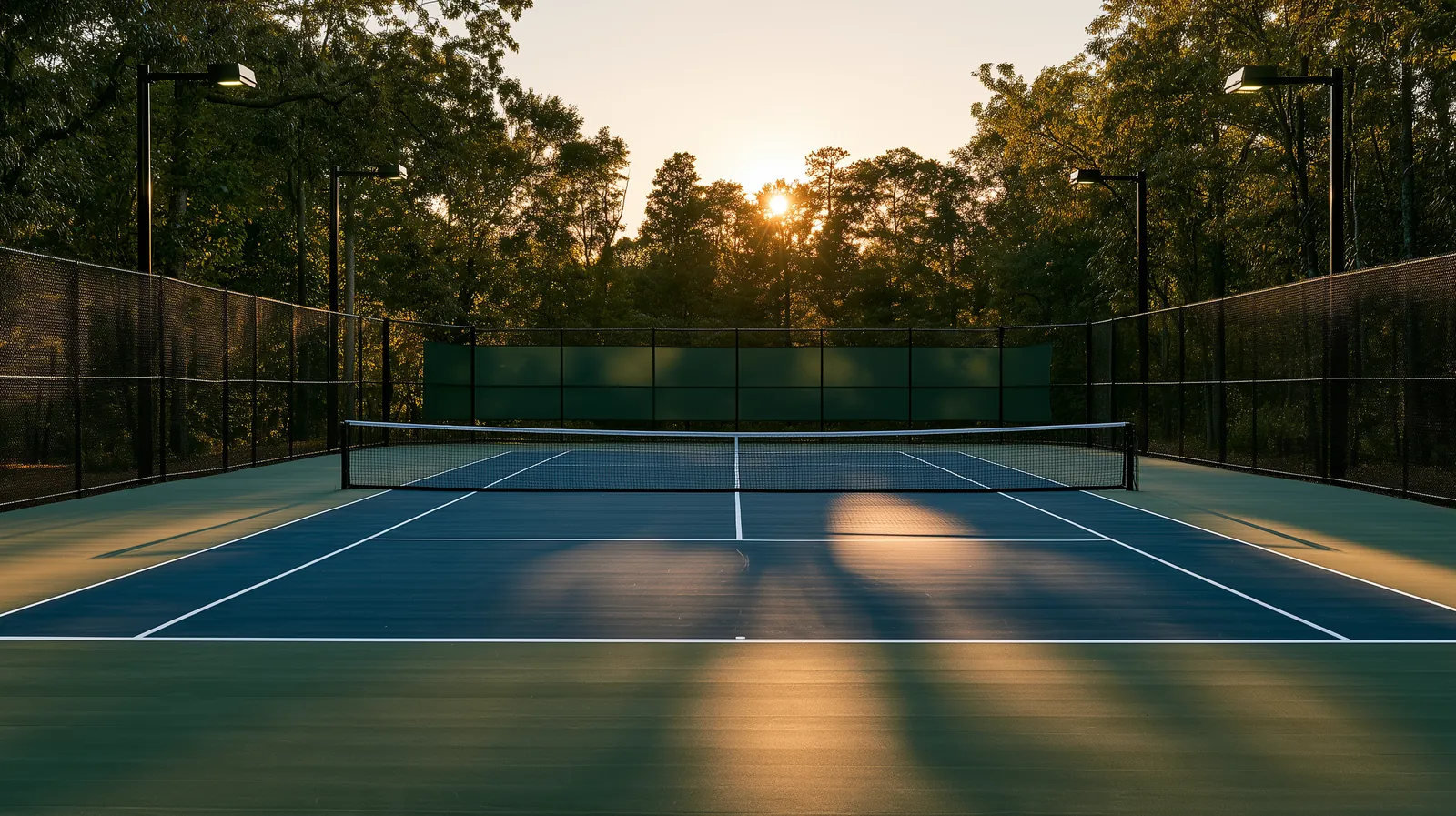
Key figures
- Court
- 78 × 36 ft inside a 120 × 60 ft recommended area
- Base
- 4–6 in compacted crushed stone over graded subgrade
- Post-tension slab
- 4–5 in cables tensioned after pour, no joints in the court
- Asphalt
- 2 lifts totaling 3–4 in, cure 14–30 days before coating
- Slope
- 1% in one plane, never toward the net
- Fence
- 10 ft chain-link, 12 ft at ends for commercial
- Build time
- 6–10 weeks for one hard court
- Cost
- $50,000–120,000 per outdoor hard court, excluding land
Free to cite with attribution and a link. Full set at courtbaseline.com/reference.
Fig. 01
What is the best tennis court base?
Post-tension concrete, for any court the owner expects to keep for 25 years. A 4 to 5 inch slab with steel cables tensioned after the pour resists the cracking that control joints and reinforcing bars only manage. Asphalt is the economical choice where the climate is mild and the owner accepts resurfacing every 4 to 8 years.
| Base | Thickness | Slab cost | Resurface interval | Best for |
|---|---|---|---|---|
| Post tension concrete tennis court | 4–5 in | $30,000–45,000 | 6–10 years | Clay soils, freeze-thaw, clubs, anyone keeping the court 20+ years |
| Reinforced concrete | 4–5 in | $22,000–35,000 | 5–8 years | Stable soils; control joints will reflect through |
| Asphalt tennis court | 3–4 in, 2 lifts | $15,000–28,000 | 4–7 years | Mild climates, parks, schools, tight budgets |
| Stone base for clay or turf | 4–8 in | $12,000–25,000 | n/a | Har-Tru, red clay, synthetic turf systems |
Sequence
How does tennis court installation work, step by step?
Nine steps over 6 to 10 weeks. The slab cure sits in the middle and cannot be rushed; every other step bends around it.
| # | Step | What happens | Duration |
|---|---|---|---|
| 1 | Survey and design | Soil report, drainage plan, north-south orientation, permit set | 1–3 weeks (before mobilizing) |
| 2 | Excavation and grading | Strip, cut and fill the 120 × 60 ft area to 1% slope, compact subgrade | 3–6 days |
| 3 | Tennis court drainage | Perimeter French drain or trench drain at the low side, outlet to daylight or storm | 1–3 days |
| 4 | Base | 4–6 in crushed stone in lifts, laser-graded, proof-rolled | 2–3 days |
| 5 | Slab | Post-tension pour and tensioning at 7 days; or two asphalt lifts | 2–4 days |
| 6 | Cure | Concrete 28 days; asphalt 14–30 days | 2–4 weeks |
| 7 | Fence, lights, net posts | Footings during cure; fabric, fixtures and post sleeves after | 3–6 days |
| 8 | Surface | Acrylic resurfacer, optional cushion layers, 2 color coats | 4–7 days |
| 9 | Lines and net | 2 in lines (4 in baselines allowed), net hung at 3 ft 6 in posts, 3 ft center | 1 day |
Why is tennis court drainage the step that decides everything?
Because water under a slab is what cracks it. A 1 percent slope sheds surface water; a stone base and a perimeter drain keep groundwater from heaving the slab in winter or softening the subgrade in spring. Hard court construction that skips the drain saves a few thousand dollars and spends it back on crack repair within five years.
The slope runs in one plane, side to side or end to end, never from the net outward and never from the center of the court. Across 120 feet, 1 percent is 14 inches of fall, which is why a court site needs to be flat to begin with or the cut and fill becomes a large number on the quote.
On clay soils, the base layer is also where expansion is managed. Builders in Texas and much of the Southeast will not warranty anything but post tension concrete on expansive soil, and the stone base under it is thicker than the 4 inches a sandy site needs.
What does an indoor tennis facility involve?
A building with 35 to 40 feet of clear height at the net and about 120 by 60 feet of clear floor per court, plus the same slab and surface as outdoors minus the slope. An indoor tennis facility is a pre-engineered steel building or an air-supported dome over a conventional court.
Indoor tennis court construction adds lighting designed to 75 to 125 foot-candles with no fixtures in the sightline above the baseline, HVAC sized for a high-volume space, and a flat slab with internal drainage at the perimeter. Courts can be laid at the minimum 110 by 56 foot spacing indoors because wind and sun are not factors, but 120 by 60 remains the comfortable standard.
The building dominates the budget. A two-court pre-engineered steel structure with insulation and HVAC starts around $1.2 million before the courts; an air dome over two existing courts is a fraction of that but is seasonal and has a 15 to 20 year fabric life.
How is a backyard tennis court built differently?
It usually is not, which is the problem. A residential tennis court needs the same 120 by 60 foot area, the same base and the same drainage as a club court. What changes is access, setbacks and whether the lot can lose 7,200 square feet to an impervious surface.
A backyard tennis court on a sloped lot is often a retaining-wall project before it is a court project, and that can double the price. Most municipalities count the court toward impervious coverage limits and require setbacks of 10 to 25 feet, which rules out many half-acre lots. Lights usually need a separate permit and a photometric plan showing spill at the property line.
Owners who do not have the space are increasingly building a 60 by 120 foot multi-sport slab with tennis lines and pickleball lines, or a smaller court for a different sport entirely. See backyard sport court for what fits on what lot.
Who does what
What kinds of tennis court contractors are there?
Regional sport surfacing contractors, who build and resurface every kind of hard court and are the bulk of the trade; tennis specialists, often ASBA certified, who do post-tension and clay work; national court companies with dealer networks; and general pavers, who can build a slab to spec and should not surface it.
| Type | Does | Best for | Watch for |
|---|---|---|---|
| Regional sport surfacing contractor | New courts, resurfacing, conversions, fencing, lighting | Most residential and club courts | Which base they default to and why |
| Tennis specialist, ASBA certified | Post-tension slabs, clay and hydro courts, multi-court complexes | Clubs, schools, premium residential | Longer lead times; worth it |
| National court company | Design and surface system through local dealers | Branded cushioned systems | Who actually pours the slab and holds the warranty |
| General paving or concrete contractor | Slab only | The base under a specialist's surface | Slope, flatness and finish spec; no coating |
| Clay court specialist | Har-Tru and red clay installation and hydro systems | Clay courts | Few of them; mostly Northeast, Florida and Mid-Atlantic |
What should you ask a tennis court builder?
The same ten questions that sort any court builder, with two that matter more for tennis: what base they are proposing for your soil, and how the court drains.
- Which base, and why for this soil? Post-tension, reinforced concrete or asphalt, with a reason. On clay soils, the answer should be post-tension.
- How does the court drain? A 1 percent slope in one plane and a perimeter drain to daylight. Ask where the water goes.
- What surface system, and is the resurfacer coat included? Named acrylic system with a resurfacer; cushioned or not.
- What is the stone base depth and compaction method? 4 to 6 inches, laser-graded, proof-rolled.
- How long do you cure before coating? 28 days concrete, 14 to 30 asphalt.
- Can I visit a court you built five or more years ago?
- Who designs and pulls the permit, and who does the photometric plan for lights?
- What does the warranty cover on the slab, separately from the surface?
- What is the payment schedule?
- Are you an ASBA member or a Certified Tennis Court Builder?
The specification those answers should meet is on tennis court construction, and every line's cost is on tennis court cost.
How do you find tennis court builders near me?
The ASBA member directory by state, the nearest club's builder, sport surfacing contractors in your metro whose sites show courts with client names, or send the project to CourtBaseline for routing to one vetted builder covering your region.
A search for tennis court contractors returns a mix of real builders, lead-resale sites and surface-system dealers. The tell for a real builder is a physical yard, courts they will name, and a surface system they will name. Lead-resale sites have a form and stock photos, and sell your inquiry to several contractors at once.
| Market | What is different |
|---|---|
| Tennis court construction Florida; tennis court builders Florida | Year-round season, the deepest bench of builders, heavy drainage design, clay and hydro court expertise, hurricane-rated fencing |
| Tennis court construction Texas | Post-tension slabs are standard on expansive clay; summer heat limits coating windows |
| Tennis court construction California | Highest labor rates, strict VOC limits on coatings, the most permitting on hillside lots |
How do you compare tennis court builder quotes?
Line by line against a standard spec. A $40,000 gap between two quotes is usually 2 inches of stone base, asphalt instead of post-tension, no resurfacer coat, and fencing and lighting left out.
| Line | Standard spec | How low quotes cut it |
|---|---|---|
| Stone base | 4–6 in compacted, laser-graded | 2 in or on graded soil |
| Slab | Post-tension 4–5 in, or asphalt 3–4 in in two lifts | Single asphalt lift; 3 in concrete with joints |
| Drainage | Perimeter drain to daylight | "Surface drainage" |
| Slope | 1%, one plane | Not specified or crowned |
| Surface | Named system, resurfacer + 2 color coats | Color only |
| Fence | 10 ft chain-link, full perimeter, gates | Excluded |
| Net and posts | Posts in sleeves, internal winders, center strap anchor | Surface-mount posts |
| Lighting | Photometric plan, poles, electrical | Excluded or fixtures only |
| Permit, design, engineering | Included | "By owner" |
Commercial and multi-court
Building more than one court?
Pairs and banks of tennis courts cost 10 to 20 percent less per court than one court alone, because the base, fence and lighting poles are shared. Two lit courts typically run $115,000 to $240,000, and post-tension concrete is the standard slab.
HOAs, schools, parks and clubs also add an approval step, a board vote or a public bid, that sets the real start date. See commercial court construction for budgets by project size, approval paths and what belongs in the specification.
Existing courts
Already have a tennis court? Resurfacing is a separate job
Tennis court resurfacing costs $6,000 to $15,000 per court for crack repair, resurfacer, two color coats and lines, and is due every 4 to 8 years. It does not fix a failed base; that is a rebuild.
Resurfacing is priced, scheduled and often quoted by different crews than new construction. See Tennis court resurfacing: cost, process and how often.
FAQ
Tennis court construction, answered
How long does it take to build a tennis court?
How much does tennis court construction cost?
How do I find tennis court construction near me?
Is a post tension tennis court worth it?
Which direction should a tennis court face?
Can a tennis court be built on a slope?
How much do tennis court builders charge?
Can a general contractor build a tennis court?
Do tennis court builders also resurface?
Read next
Cost, dimensions and resurfacing
Start the project
Ready to build a tennis court?
Send the site and the surface you want and we will connect you with one builder covering your region. Free, no bidding pool.