Construction guide · Updated 2026
Pickleball court construction
and installation
Pickleball court construction is a paving job with a sport surface on top: a graded and compacted base, a 4 inch concrete or 2 to 3 inch asphalt slab sloped 1 percent for drainage, an acrylic color coating system, 2 inch lines, a net on 2 posts and a 10 foot fence. One outdoor court takes 4 to 8 weeks including curing and costs $20,000 to $40,000; a four-court complex takes 8 to 14 weeks.
The work is done by pickleball court builders: sport court contractors who handle the base, slab, coating, fence and net in one contract. A paving contractor alone usually stops at the slab and hands off to a surfacing installer.
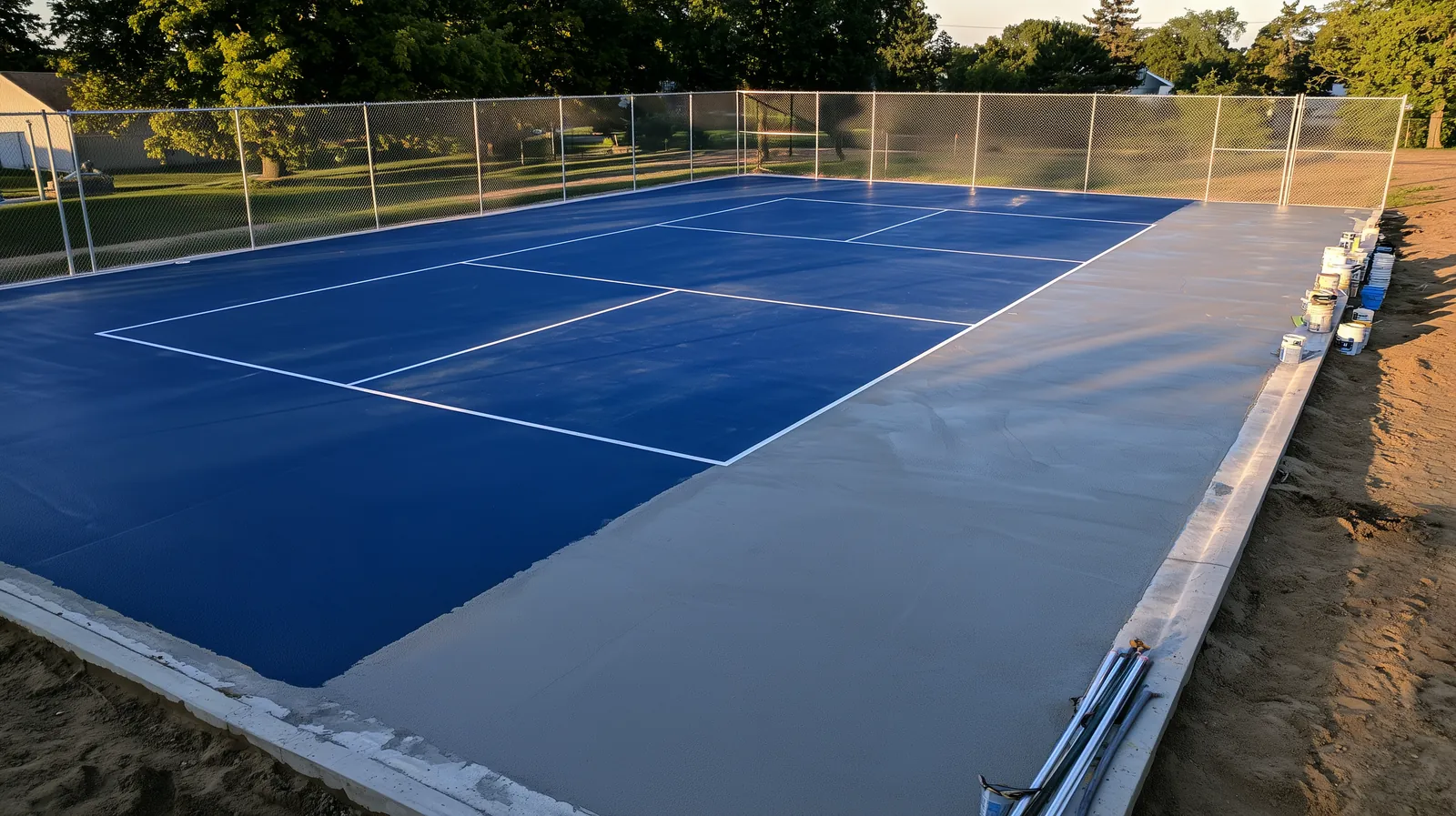
Key figures
- Court
- 44 × 20 ft inside a 34 × 64 ft recommended playing area
- Slab
- 4 in reinforced concrete, or 2.5–3 in asphalt over 4–6 in stone
- Slope
- 1% (1 in per 8 ft 4 in) in one plane, side to side or end to end
- Surface
- Acrylic resurfacer plus 2 color coats, optional cushion layer
- Cure before coating
- Concrete 28 days, asphalt 14–30 days
- Fence
- 10 ft chain-link, 4 ft minimum where budget limits
- Build time
- 4–8 weeks for one court, 8–14 for four
- Cost
- $20,000–40,000 per finished outdoor court
Free to cite with attribution and a link. Full set at courtbaseline.com/reference.
Fig. 01
What are the layers of a pickleball court?
Five, from the ground up: compacted subgrade, crushed stone base, the slab, the acrylic surface system and the lines. The slab is the structural decision; everything above it is a coating.
Sequence
How does pickleball court installation work, step by step?
Eight steps. The first four are civil work any paving contractor can do; the last four are where a specialist pickleball court builder earns the premium.
| # | Step | What happens | Duration |
|---|---|---|---|
| 1 | Site and layout | Soil check, drainage plan, court orientation north-south, stake the 34 × 64 ft area | 1–3 days |
| 2 | Excavation and grading | Strip topsoil, cut to grade with the 1% slope built in, compact subgrade | 2–4 days |
| 3 | Base | 4–6 in crushed stone, compacted in lifts, perimeter drain if needed | 1–2 days |
| 4 | Slab | 4 in reinforced concrete (or post-tension), or 2.5–3 in asphalt in two lifts | 1–3 days |
| 5 | Cure | Concrete 28 days; asphalt 14–30 days to release oils before coating | 2–4 weeks |
| 6 | Fence and lights | Posts set in concrete during cure, fabric and fixtures after | 2–4 days |
| 7 | Surface | Acid etch or prime, acrylic resurfacer, optional cushion, 2 color coats | 3–5 days |
| 8 | Lines, net, posts | Tape and paint 2 in lines, set net posts in sleeves, hang net at 36/34 in | 1 day |
Concrete or asphalt for a pickleball court?
Concrete lasts longer and stays flatter; asphalt is cheaper up front and faster to build. In freeze-thaw climates or on reactive clay soils, post-tension concrete is the only base that reliably stays crack-free. In mild climates on good soil, asphalt is a defensible choice if you accept resurfacing every 5 to 8 years.
A standard 4 inch concrete slab with rebar or fiber mesh costs $10,000 to $18,000 per court and will show control-joint cracks that need sealing. Post-tension concrete, where steel cables are tensioned after the pour, costs $18,000 to $25,000 and needs no joints inside the court, which is why it has become the default for commercial pickleball court construction. Asphalt costs $6,000 to $12,000, cures faster, and is what most park and school courts are built on.
Whichever you choose, the slab must be built with the slope in it. Coatings do not fix a flat slab; they just make the puddles the same color as the court.
Indoor pickleball court construction skips the slab question. An existing warehouse or gym floor gets a modular tile or cushioned acrylic system on top, so the project is flooring, lighting and HVAC rather than paving. See indoor pickleball facility.
What surface goes on a pickleball court?
An acrylic color coating system, the same family used on hard tennis courts: a sand-filled resurfacer to level the slab, then two coats of pigmented acrylic with silica for texture. A cushioned system adds rubber-filled layers under the color coats for $3,000 to $6,000 more per court.
Line color should contrast with both the court and the out-of-bounds color, which is why most new courts are a two-tone scheme with white or yellow lines. For a full discussion of systems, textures and the Sport Court style modular tiles used indoors and in backyards, see pickleball court surface.
What changes for commercial or indoor pickleball court construction?
Scale and permitting. A commercial pickleball court complex of 6 to 12 courts shares fencing, lighting poles and drainage, which cuts the per-court cost, but it adds a site plan, parking, ADA routes, stormwater and often a noise study.
Pickleball facility construction at that scale is a general-contractor project with a court specialist as a sub, not the other way round. Budget 10 to 20 percent on top of the hard costs for permits, engineering and utilities, and plan courts in pairs or quads so fence runs and light poles serve two courts each. Shared-pole LED lighting drops from $8,000 to $15,000 per court to $5,000 to $9,000 across four or more.
Noise is the permitting issue of the decade for pickleball. Orient courts away from residences, keep 150 feet or more of separation where you can, and price acoustic fence screens into any site closer than that.
Can you build a DIY pickleball court with a pickleball court kit?
Partly. A DIY pickleball court on an existing flat driveway or slab is a weekend project with a pickleball court kit: a portable net, line tape and a few hundred dollars. Building the slab yourself is not a weekend project, and most people who try end up hiring the paving out and doing only the surface and lines.
A pickleball court kit from the major net brands runs $150 to $700 for a regulation net system with posts, plus $30 to $80 for line tape or stencils. On a sound existing slab you can also DIY the acrylic coating, which is sold in kits sized for one court for about $1,500 to $3,000 in materials. The parts that need a pro are grading, drainage, paving and, if you want it to last, the resurfacer coat that levels the slab.
Pickleball court installation on a driveway has one catch: driveways are sloped more than 1 percent, and the ball notices. If yours falls more than about 8 inches across the 64 foot length, play across the slope rather than down it.
Who does what
What kinds of pickleball court contractors are there, and who are pickleball court installers?
Three. Sport surfacing contractors, who are the core of the trade and usually came from tennis. Modular tile dealers, who sell a branded tile system and subcontract the slab. And general pavers or concrete contractors, who can build the slab and should not be asked to coat it.
| Type | Does | Best for | Watch for |
|---|---|---|---|
| Sport surfacing contractor | Full court: base, slab, acrylic, lines, nets, fence; also resurfacing | Dedicated courts, clubs, parks, conversions | Which surface system they use and whether they include a resurfacer coat |
| Tennis court builder | Same as above, often with post-tension expertise | Multi-court complexes, premium residential | Pickleball-specific layout knowledge; some still space courts like tennis |
| Modular tile dealer | Tile surface over a slab they subcontract | Backyard multi-sport courts | Whether the slab is in the quote and who warranties it |
| General paving or concrete contractor | Slab only | The base under a specialist's surface | Slope, finish and flatness spec; do not let them coat it |
| Fence, lighting, net suppliers | One component | Subs to the builder | Coordination falls to you if you hire them direct |
What should you ask a pickleball court builder?
Ten questions, in the order they sort the field. A builder who answers the first five without hesitation is in the trade; one who answers all ten is the one you want.
- Which surface system do you use, and is a resurfacer coat included? Named acrylic systems with a resurfacer coat are the standard; color over bare slab is not.
- What slab are you proposing and why? Asphalt, reinforced concrete or post-tension, with a reason tied to the soil and the climate.
- What is the slope and in which direction? One percent, one plane. A builder who says "we crown it" is building a parking lot.
- How thick is the base and how is it compacted? Four to six inches of stone in lifts, proof-rolled.
- How long do you cure before coating? Twenty-eight days on concrete, 14 to 30 on asphalt. Shorter means the coating will peel.
- Can I see a court you built more than three years ago? New courts all look good.
- What does your warranty cover, and for how long? Surface 1 to 2 years is normal; slab warranties separate the serious from the rest.
- Who pulls the permit and who designs the drainage? The builder should.
- What is the payment schedule? A deposit, a progress payment at slab, balance on completion.
- Are you an ASBA member or Certified Builder? Not required, but a signal.
The full specification a quote should meet, from slope to line width, is on pickleball court construction.
How do you find pickleball court builders near me?
Search the ASBA member directory by state, search for sport surfacing and tennis court contractors in your metro and check their pickleball work, ask the nearest club who built its courts, or send your project to CourtBaseline and we will route it to one vetted builder covering your region.
"Pickleball court installers" and "pickleball court contractors" in a search return a mix of real builders, lead-generation sites that sell your inquiry to several of them, and tile dealers. A real builder has a physical address, photos of courts with the client's name, and a surface-system brand on its site. A lead-gen site has a form and stock photos.
| Market | What is different |
|---|---|
| Pickleball court construction Florida; pickleball court builders Florida | Year-round trade, deep competition, heavy drainage design, mildew-resistant coatings; the deepest bench of builders in the country |
| Pickleball court construction Texas; pickleball court builders Texas | Post-tension slabs dominate because of expansive clay soils; summer heat pauses coating work |
| Pickleball court construction California | Highest labor rates, the most permitting and CEQA exposure on commercial sites, strict VOC limits on coatings |
How do you compare pickleball court builder quotes?
Line by line, not by total. Two quotes for the same court commonly differ by $10,000, and the difference is usually in the slab thickness, the base depth, whether a resurfacer coat is included, and whether fencing and lighting are in or out.
| Line | Standard spec | How low quotes cut it |
|---|---|---|
| Stone base | 4–6 in compacted in lifts | 2 in or none, on graded soil |
| Slab | 4 in reinforced concrete or 3 in asphalt in two lifts | 3 in concrete, single asphalt lift |
| Slope | 1% one plane, laser-set | Not specified |
| Surface | Resurfacer + 2 color coats, named system | Color coats only, unnamed product |
| Lines | 2 in, taped and painted | Sprayed freehand |
| Net system | Permanent posts in sleeves | Portable net |
| Fence | 10 ft chain-link, full perimeter | Excluded or 4 ft |
| Cure | 28 days before coating | 7 to 14 days |
| Permit and drainage design | Included | "By owner" |
Costs for each line are on pickleball court cost.
Commercial and multi-court
Building more than one court?
Banks of four or more pickleball courts price at about $15,000 to $30,000 per court before lights, against $20,000 to $40,000 for a single court, because the slab, perimeter fence, lighting poles and crew mobilization are shared. A lit four-court complex runs $80,000 to $160,000.
HOAs, schools, parks and clubs also add an approval step, a board vote or a public bid, that sets the real start date. See commercial court construction for budgets by project size, approval paths and what belongs in the specification.
Existing courts
Already have a pickleball court? Resurfacing is a separate job
Pickleball court resurfacing costs $4,000 to $8,000 per court for a full acrylic system with crack repair, or $1,500 to $3,500 for a recoat on a sound court. It is due every 5 to 8 years.
Resurfacing is priced, scheduled and often quoted by different crews than new construction. See Pickleball court resurfacing: cost, process and how often.
FAQ
Pickleball court construction, answered
How long does pickleball court construction take?
How much does pickleball court construction cost?
How thick should a pickleball court slab be?
How do I find pickleball court construction near me?
Which direction should a pickleball court face?
Do I need a permit to build a pickleball court?
How much does a pickleball court builder charge?
Can a concrete contractor build a pickleball court?
Do pickleball court builders need a license?
Read next
Price it, size it, find a builder
Start the project
Ready to build a pickleball court?
Send the site and the number of courts and we will connect you with one builder covering your region. Free, no bidding pool.